EcoPlastiC Year 3 Review Meeting

Three years have passed quickly and the EcoPlastiC project has now reached its conclusion. What began as a vision for advancing sustainable biopolymers has developed into a comprehensive journey of innovation, collaboration and impact. Over this period, partners have worked together to deliver significant scientific results, engage diverse audiences, and build strong connections with stakeholders across Europe and beyond. The final EcoPlastiC Review Meeting with the Project Officer Lazaros Perakis, PhD took place on 18 November 2025 online. Scientific experts Dr Monica Trif, Dr Alessandro Pellis and Dr Nikoletta Athanasopoulou (Innovation Radar expert) were also present, as they were appointed in advance to examine the overall progress and achievements of the project.
WP1 (led by TUS, Ireland) ensured the smooth execution of the EcoPlastiC project, maintaining strong partner collaboration and timely progress throughout its duration. All 25/25 deliverables on time. The regular Steering Meetings and General Assemblies supported effective coordination.
WP2 (also led by TUS, Ireland) developed high-yield, scalable monomers from the reactive extrusion (REX) and biocatalytic depolymerisation processes for mixed PET waste, including textile-derived PET. The REX process achieved >99% TPA yield and demonstrated industrial scalability reaching 59 kg/h with stable long-term operation at 44.25 kg/h. Life Cycle Assessment (LCA) confirmed the environmental promise of the process and its alignment with circular bioeconomy principles. In parallel, biocatalytic routes enabled microbial degradation of PET-containing textiles with Streptomyces strains emerging as highly promising candidates.
WP3 (led by AVE, Belgium) isolated, enriched and optimised aerobic and anaerobic microbial communities capable of converting depolymerised REXed PET into PHA and protein-rich biomass. A total of 39 strains were evaluated, including 29 new isolates. Aerobic processes consistently outperformed anaerobic ones, achieving up to 97% COD removal. Pure cultures mainly produced high-protein biomass, with Delftia tsuruhatensis and Glutamicibacter nicotianae identified as top performers (up to 80% protein content). NOVA’s mixed culture achieved the highest PHA productivity, with up to 40% PHA content.
WP4 (led by NOVA, Portugal) scaled up PHA and protein-rich biomass production with promising mechanical properties, optimised green extraction processes and produced biopolymer materials suitable for packaging applications. Three biological processes were successfully scaled: mixed culture (25 L), G. nicotianae strain 24A (10 L) and strain DM-14 (17% PHA). Enzymatic extraction methods enabled 80–100% PHA recovery without compromising polymer properties. A novel Tenebrio molitor enzyme cocktail obtained by IMGGE provided efficient extraction across PHB, PHBV and mcl-PHA at 10× lower enzyme loads than commercial alternatives. Thymol-based NADES enhanced PHB recovery up to 92% with solvent recycling. Biomass streams from mixed cultures and strain 24A were successfully processed into plastic materials, including novel bio-polyurethanes incorporating bacterial biomass.
WP5 (led by KTH, Sweden) transformed PHA and microbial protein biomasses into functional packaging demonstrators and evaluated their performance, recyclability and environmental behaviour. Films, trays, coatings, adhesives and multilayer materials were developed using combinations of PHA, SCP, PHBV, PHBH, PCL and PBAT. Several materials demonstrated mechanical recyclability through multiple repressing cycles. Hydrolytic degradation and soil biodegradation studies confirmed biodegradability. Two key technologies including CicloSeal bio-adhesive and CicloPack multilayer films were supported by market validation through Enterprise Ireland. High-visibility demonstrators included trays, tokens, coat hangers and 3D-printed PHB shoes derived from PHA and microbial protein biomasses.
WP6 (led by IMGGE, Serbia) coordinated dissemination, communication, exploitation, stakeholder engagement and Open Science activities. Across the three years, partners delivered 175 dissemination activities, published 15 peer-reviewed articles (with eight more in preparation) and participated in 29 conferences with 46 scientific contributions. The consortium generated 15+ proposals based on EcoPlastiC knowledge, resulting in four funded follow-up projects, and EcoPlastiC innovations were highlighted twice by the EU Innovation Radar.
The achievements demonstrate that the project approached these activities with seriousness and dedication, reaching thousands of people and ensuring that EcoPlastiC’s outcomes will continue to resonate. This final stage marks not only the end of the project, but also the beginning of its legacy, as the knowledge and networks established will support future advances in biotechnology and sustainable materials.
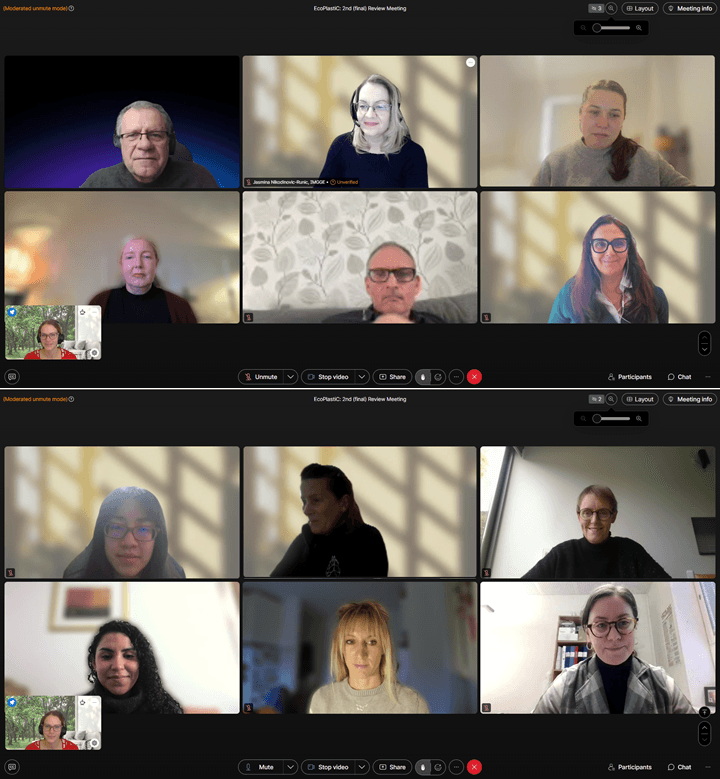
External reviewers and the Project Officer commended the consortium for its robust technical achievements, high-quality results and strong interdisciplinary collaboration. They were very pleased with the progress of the project, the deliverables, the research results and output, as well as Consortium communication (internal and external) and dissemination. The experts encouraged the consortium to adopt a more coordinated exploitation strategy: identifying the most promising technologies, defining unique selling points and assessing scalability and market relevance. The Consortium welcomed this guidance and is committed to leveraging these insights to maximise the impact and long-term sustainability of EcoPlastiC innovations.